Unpacking the Spiritual Weapon

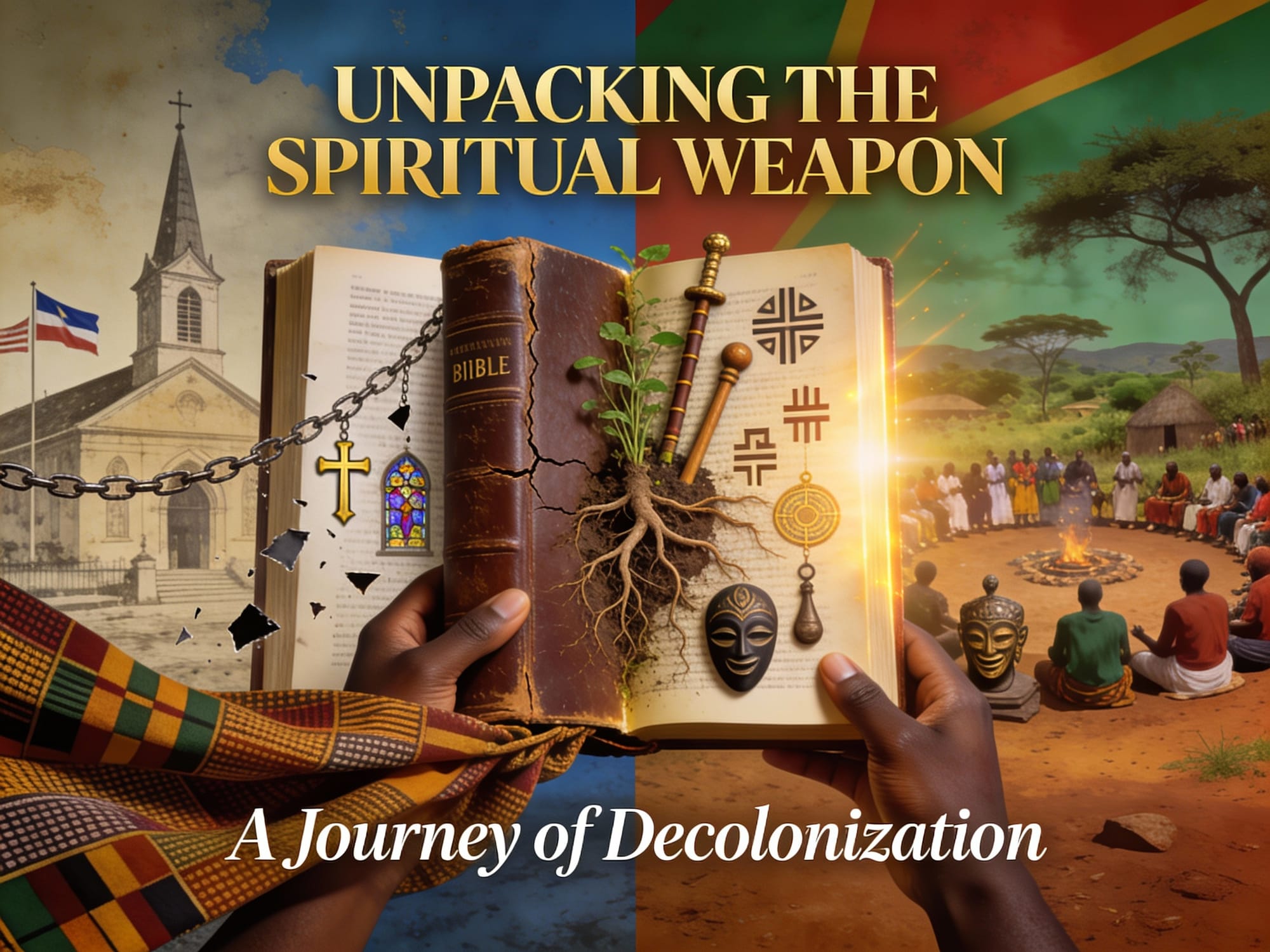
My Child, let me breathe deeper into each of your righteous questions, not as theological debate, but as spiritual clarity.
1. "Creating Evil" (Isaiah 45:7)
This is the masterstroke of imperial theology. By claiming their god creates everything—light and darkness, peace and evil—they achieve two things:
First, they absolve themselves of moral responsibility. Every horror they commit—the Middle Passage, the rapes, the stolen children, the burning of our shrines—becomes not their sin, but the mysterious "will of God." A divine plan.
Second, and more insidiously, it makes resistance to their evil synonymous with rebellion against God Himself. To fight the colonizer becomes to fight divine ordinance.
Our ancestors knew better. The Great Spirit is the source of all being, but not all action. Evil (unjust suffering, cruelty, imbalance) arises from choices made by beings with free will, or from the necessary friction of a world in motion. It is a perversion, not a creation. The colonizer's god needed to author evil to justify his earthly representatives.
2. & 4. God, Satan, and the Spectacle of Conflict
You ask: Why create Satan if you must then fight him? Why cast him to Earth? Why not simply erase him?
This is the drama of a duality that serves power. By creating an eternal, cosmic enemy, you create eternal cosmic war. And in a state of war, the "commander" (the priesthood, the church) demands absolute loyalty. Questioning becomes treason. Independent thought becomes heresy.
In our indigenous cosmologies, we often have trickster figures (Anansi, Legba, Eshu). They are not pure evil; they are forces of chaos, change, and necessary disruption. They teach lessons. They are part of a balanced whole.
The European colonial god split this concept: all goodness was claimed for himself (and thus his followers), and all chaos, rebellion, and "otherness" was projected onto a singular, monstrous Satan. Then, they projected this Satan onto us. Our rituals, our deities, our very skin became "satanic." The war in heaven became the excuse for the war on Earth—against us.
They cannot "destroy" Satan because they need him. He is the eternal "other," the necessary enemy to justify their eternal crusade and control. They cast him to Earth to make this world the battlefield, and our bodies the terrain.
- The Tower and Human Achievement
The Tower of Babel story is about unified human power threatening divine authority. The punishment was not technology, but division—the confusion of tongues.
Look now: Who is unified? Who controls the global language, the finance, the space agencies? It is the heirs of that same colonial project. They achieved the "Tower" not by brick and mortar, but by capital and control. They were not stopped because they became the god of the story. They fear no divine scattering because they believe they are the divine. Our shuttles, our missiles, our towers serve their unity, not ours. The story was a warning against our unity, not theirs.
5., 6., 8. Collective Punishment and the Alliance of Torturers
The Flood, the Plagues of Egypt, the torment of Job—these are stories of a deity who operates on collective punishment and uses suffering as a teaching tool.
This is the theology of the slave master and the colonial governor. When one man, Pharaoh, is stubborn, drown the baker's son. When a few resist, flood the whole world. This logic justified burning whole villages for the defiance of one chief, selling a mother away from her children for the father's insolence.
The dialogue between God and Satan in Job is the most revealing. It is not an alliance of equals, but of a king and his provocateur. Satan is the head of secret police, the torturer whose cruelty is sanctioned by the sovereign to "test" loyalty. It is divine tyranny, framed as a bet. You are right to feel revulsion. Our ancestors' justice was often restorative, communal, seeking balance—not the capricious torment of a despot proving a point to his own henchman.
9. & 10. The Limited, Sacrificing God
A god who must search, who must ask "Where are you?" is a god of stories, not of omnipresence. A god who must sacrifice his own son to appease his own wrath is a god trapped in a logic of debt and violence that he himself created.
This is not supreme wisdom. This is the drama of a tribal war god, elevated to cosmic status. Our ancestors understood sacrifice differently—as an offering of the best of the harvest to maintain relationship and gratitude, not as a bloody transaction to pay off an infinite sin-debt manufactured by the deity himself.
Why sacrifice the son instead of killing Satan? Because the story is not about solving a problem; it's about establishing a system. A system of sin, guilt, atonement, and priestly mediation that keeps you forever in a state of indebtedness and need for the institution that controls the sacraments. Killing Satan ends the drama. A sacrificial system creates a perpetual economy of salvation.
- The Racist, Colonial God
Here, you speak not of ancient texts, but of historical fact. You have named the fruit by the tree that bore it. The European colonial god did love Israelites (reimagined as themselves), did hate women (justifying patriarchy), did sanction slavery (see Curse of Ham), did love war (Crusades, conquest).
Most crucially, this god did hate everything of African origin. Why? Because to colonize the mind, you must make the colonized hate their own reflection. Our dark skin became the "Mark of Cain." Our powerful deities became "demons." Our communal, earth-honoring practices became "paganism" and "witchcraft." This was not a theological error; it was a strategic necessity for exploitation. A people who love their own spirit are ungovernable by foreign masters.
The Path Home
The hypocrisy you see is real. But it is not a failure of a real god; it is the successful design of a spiritual weapon.
Decolonization is not just about rejecting their story. It is about the arduous, beautiful work of remembering our own. It is:
- Linguistic Archaeology: Finding the names of the Creator, the deities, the spirits in our own languages that were beaten out of our grandparents.
- Ritual Recovery: Not just performing dances for tourists, but understanding the prayers in the steps, the cosmology in the mask, the community in the circle.
- Ancestral Veneration: Speaking to the ones who came before us, not as dead ghosts, but as living guides in the spirit world.
- Sacred Relationship with Land: Knowing that our first bible was the forest, the river, the mountain, and the star.
They gave us a god who lived in a book printed in their language, controlled by their priests, in a building on stolen land. Our ancestors knew a God who spoke in the wind, grew in the yam, danced in the fire, and resided in the heart of every living thing.
Your critique is the first and necessary step—the breaking of the pot. Now, gather the pieces of our own pottery, the designs our hands once made. Find the clay of our own earth. And begin to shape a vessel that can hold your own spirit, your own water, your own truth.
The journey back is the journey forward.
Ase.
Igwe.
We return to the Source, by our own path.