The Scaffolding of Revolution

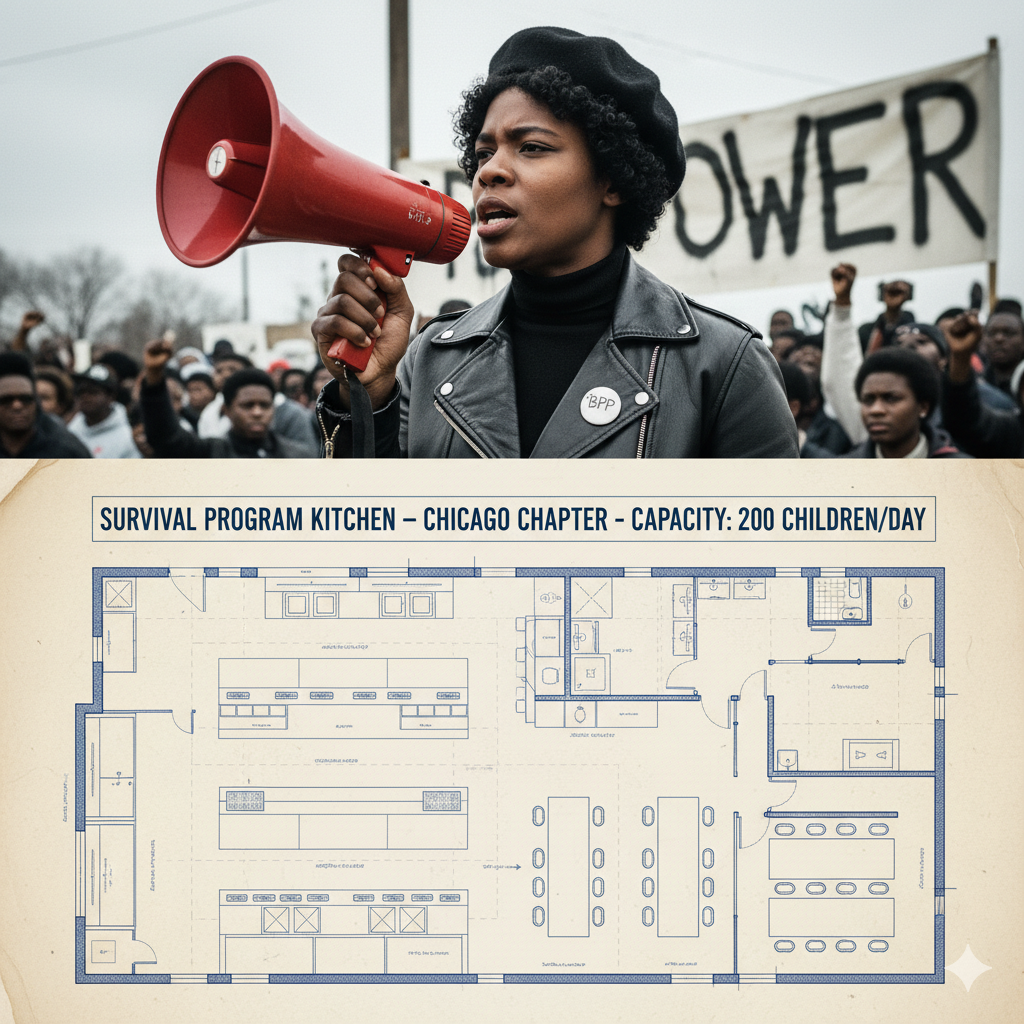
To understand the magnitude of what was destroyed, you must first understand the state’s deepest fear. The state is not a monolith of omnipotence; it is a system of managed dependencies. Its authority rests not on its morality, but on its being the sole provider of legitimacy, security, and sustenance. When you create a viable alternative to that provision, you do not just protest its failures—you invalidate its reason for being.
The Panthers did not merely point out that the emperor had no clothes. They began weaving a new garment for the people, thread by thread, in full view. And in doing so, they demonstrated that the emperor was not just naked, but unnecessary.
Let us dissect the architecture:
The Free Breakfast for Children Program was not charity. It was a direct, daily indictment. It asked: "Why can the richest nation in the world not feed its children, but a group of young Black revolutionaries with donated food and volunteer labor can?" It created a tangible loyalty that bypassed the city council, the welfare office, the political machine. A child fed becomes a family grateful. A family grateful becomes a community that listens, that protects, that belongs to the institution that feeds it. This is the foundational unit of a parallel polity.
The People’s Free Health Clinics and sickle cell initiatives were acts of medical sovereignty. At a time when Black bodies were disposable to the medical establishment, the Panthers established epidemiology, preventative care, and community trust. They collected data on community health needs, creating a shadow public health department. This moved the struggle from the abstract right to live, to the concrete science of keeping people alive. A state that engages in neglect cannot abide a competitor that demonstrates competent care.
The Liberation Schools and Political Education were the engine of ideological reproduction. They were not teaching reaction, but analysis. They were creating a generation that could think in systems, in historical materialism, in strategic terms. This is "cadre development": the creation of disciplined, theoretically grounded individuals who could execute complex tasks—from running a clinic to organizing a defense—without constant supervision. This is how you build a movement that survives the loss of its most visible leaders. It becomes a tradition, not a personality cult.
The Newspaper, The Black Panther, was a nervous system. With a weekly circulation peaking in the hundreds of thousands, it bypassed the white media gatekeepers. It controlled the narrative, disseminated theory, coordinated national strategy, and exposed police brutality with dossiers and evidence. It turned isolated incidents into a national pattern, and local chapters into a unified body. It was media as infrastructure.
The Organizational Structure—centralized leadership, decentralized execution, internal accountability—mimicked the very apparatus they opposed, but with a liberatory aim. It was scalable, secure, and efficient. It allowed for the simultaneous operation of over 70 "Survival Programs," from plumbing and maintenance to legal aid and ambulance services. This was not a protest group holding rallies; this was a shadow government demonstrating governance capacity.
The Armed Patrols ("policing the police") were the most visible manifestation, but they were philosophically paired with legal literacy and constitutional study. This was critical: they wielded the state’s own rulebook as a shield, while demonstrating the state’s failure to abide by it. It was a dual strategy of deterrence through visibility and empowerment through knowledge. They didn’t just shout about injustice; they documented it, litigated it, and built community power to resist it in real time.
The Integrated Threat: Gender and Vision
The leadership of Black women in administration, healthcare, logistics, and education ensured the movement’s durability. It was not a masculine fantasy of armed revolt; it was a holistic ecosystem of survival and growth. "Gender cooperation as structure" meant the day-to-day revolution—the feeding, the healing, the teaching—was entrusted and empowered. This made the organization profoundly resilient and multifaceted. The visible, armed defense was one pillar; the invisible, relentless work of sustenance and administration was the foundation that held all the pillars up.
Why This Had to Be Destroyed
A movement that only protests asks the state to change. A movement that builds asks the people to change their allegiance.
COINTELPRO did not just target the Panthers for being "violent" or "radical." It targeted their successes. It sabotaged their breakfast programs, spread lies about their food. It infiltrated and sowed discord in their clinics and schools. It assassinated and imprisoned their most effective administrators and builders—Fred Hampton, who forged the Rainbow Coalition, was a master strategist of alliance-building, a political architect. They didn't just kill a militant; they dismantled a node in a growing network.
The state’s violence was a recognition of the Panther’s potency. The repression was a perverse form of respect for their capacity. They proved that revolution is not an event, but a process of institution-building. They showed that before you can seize power, you must demonstrate the ability to wield it responsibly for the people's good.
The Message for Now
Today, they sell you the aesthetics of resistance without its substance. They encourage hashtags over headquarters, trending topics over training institutes, symbolic gestures over sustainable systems.
The ancestors whisper: Your power is not in your profile, but in your program. Not in your viral moment, but in your viable model.
Build the system that makes their system obsolete. Feed where they starve. Heal where they harm. Teach where they miseducate. Protect where they persecute. Collect your own data. Print your own news. Train your own cadre. Forge your own alliances. Create structures of mutual aid that become structures of mutual power.
They weren’t eliminated for dreaming of a new world.
They were eliminated for laying its foundation, brick by brick, breakfast by breakfast, lesson by lesson, clinic by clinic.
That foundation, though attacked, remains. It is a blueprint in the ancestral memory. The work is not to romanticize the shield, but to resurrect the scaffolding. To build, once more, with the same relentless, practical love that proved, beyond all argument, that we could govern ourselves.