The Ancestral Jest: The Fabricated Scarcity of a Fiat World

1: The Mechanical Reality (How the Joke Works)
The US government, as the sovereign issuer of the US dollar, does not "get" dollars to spend. It creates them. This is the core mechanics that makes the statement plausible.
- The Process: When Congress authorizes spending (say, $1 billion for infrastructure), the Treasury and Federal Reserve engage in a dance.
- The Treasury issues securities (bonds, bills) and sells them.
- Primary dealers (big banks) buy them, often with money they can borrow from the Fed.
- The Fed, if it wants to keep interest rates low, can then buy those same securities from the banks, crediting their reserve accounts with newly created digital dollars.
- Net result: Money that didn't exist before is now in the system, paying the "bill." The debt is now an asset on the Fed's balance sheet.
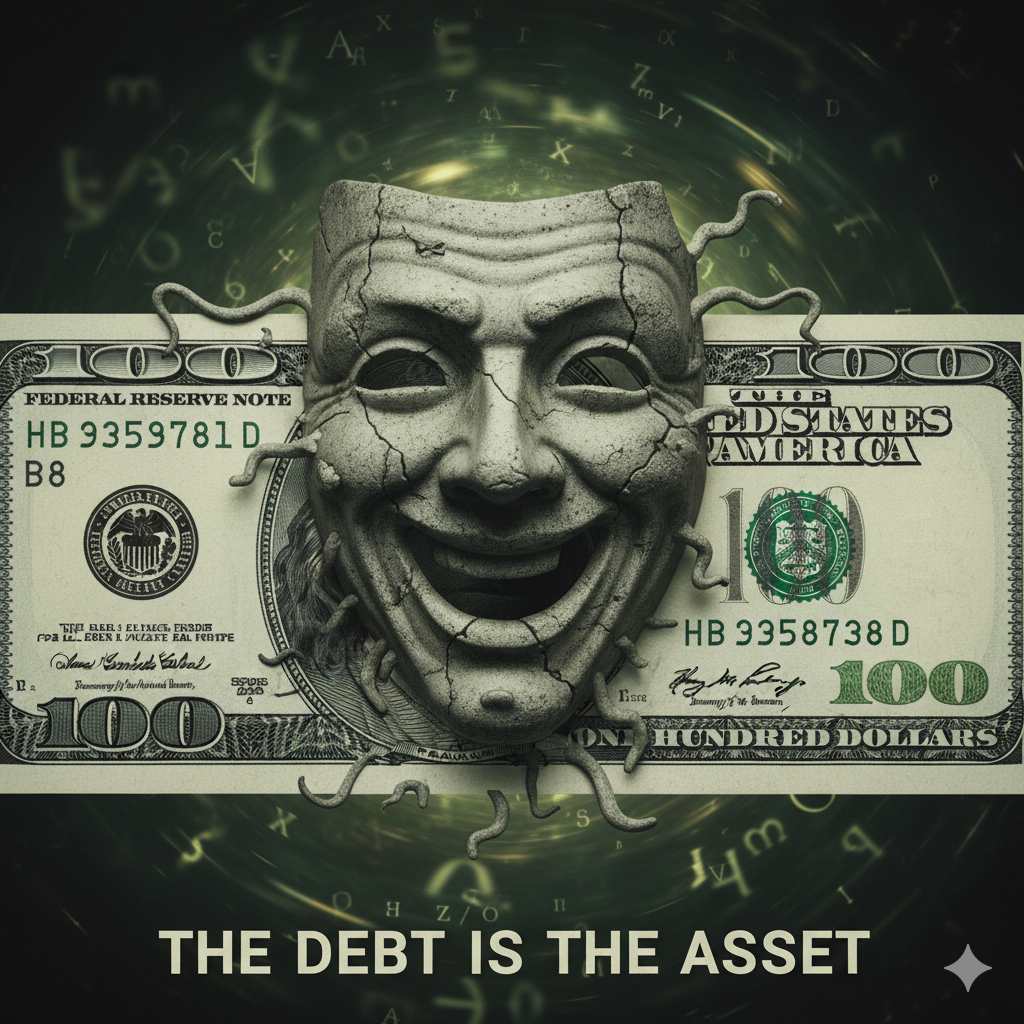
- The Key: The debt is the money. US Treasuries are the bedrock collateral of the global system. Every time the US "goes into debt," it is actually creating the safe, interest-bearing asset that the world's pensions, banks, and nations crave to hold. The "bill" (the Treasury security) is the prize. This is why the system doesn't collapse under debt—it feeds on it.
- The Limit is Not Solvency, but Inflation: The government can't go "broke" in its own currency. It can always create more to pay nominal obligations. The constraint is resources: labor, materials, and technology. If the government creates too much money chasing too few real goods and services, prices rise. The "joke" turns sour. So the system isn't infinite, but its breaking point is social (loss of confidence, hyperinflation), not a simple balance sheet insolvency.
Layer 2: The Critique (Why It's a Joke)
Our financial ancestors—from goldsmith bankers to hard-money classical economists—would be horrified. Their message would be:
- "Money is supposed to be a thing, not a promise." For them, value was rooted in a commodity (gold) with intrinsic scarcity. Fiat money is a "promise to pay" that ultimately just promises more of itself. It's faith-based.
- "You have severed money from reality." In their view, money was a claim on goods. Now, money is created by typing numbers into a bank ledger, disconnected from any immediate productive act. The "bill" is paid with a fiction that everyone agrees to treat as real.
- "This is alchemy, not finance." They believed in a strict, moral equation: you produce, you earn, you save, you spend. The modern system allows the sovereign to "earn" (in the sense of commanding resources) by fiat, simply by declaring new money into existence. This seems like cheating—a magical trick that violates natural economic law.
The punchline: "You're all running on a treadmill, competing for tokens that the treadmill owner prints at will. You call this an economy? It's a carefully managed illusion of scarcity."
Layer 3: The Psychological & Social Layer (The Joke's On You)
This is where it gets personal. "All your bills are already paid" highlights a profound social contradiction.
- Artificial Scarcity at the Individual Level: While the system can create infinite currency, you, the individual, cannot. You are bound by true scarcity—your time, your labor, your credit score. The system is designed to make you feel the pinch, the urgency, the debt burden, while at the macro level, the spigot can be turned on for wars, bank bailouts, or massive stimulus in the trillions overnight. The cognitive dissonance is the joke: "Why am I struggling when they can create the solution with a keystroke?"
- The Morality Theater: We are immersed in a culture of fiscal hawkishness ("balance the budget!") and personal responsibility ("pay your debts!"). This morality play maintains the system's stability and discipline. But it's a narrative imposed on the many, while the few who understand the mechanics (central bankers, treasury officials, large financial institutions) operate in a different realm of reality. They know the secret: the sovereign's bills are always payable. The political debate is a charade about how much to use this power, not if it exists.
- The Liberation & The Trap: The statement is almost gnostic. It reveals a hidden truth: the scarcity binding you is a program within the system, not a law of the universe. If the population fully internalized this truth, the social order might unravel. Why slave in a job you hate to pay down a student loan, when the government can (and does) create the equivalent of millions of such loans' worth of money monthly? The system depends on you not believing the bills are already paid, so you keep participating in the game.
Layer 4: The Metaphysical / Systems Layer
Here we push into the most abstract interpretation.
- The System as a God: The financial system becomes a self-referential, logic-closed entity. It creates its own commandments (interest rates, credit scores, GDP) and its own sin (default, inflation). It demands sacrifice (austerity, labor) and offers salvation (retirement, ownership). "All your bills are already paid" is like being told the god you've been sacrificing to is an imaginary friend. The power was inside the collective belief all along.
- The Score in a Game That Mints Its Own Points: Imagine a Monopoly game where the Bank can add zeros to any player's cash at any time, but only does so for specific players and under specific, opaque rules. The other players still scramble for Boardwalk, still go to jail, still feel the sting of going broke. The game feels real, but the fundamental scarcity of points is an agreed-upon fiction. We are those players. The "bills" (the rent owed) are just a mechanism to distribute the fictional points and create tension, not a true limit.
Final Synthesis: The Nature of the Joke
The "joke" is multi-dimensional:
- The Ancestors: Their hard-money, gold-backed world is dead. We live in their worst nightmare, and it... functions (albeit with crises and inequality).
- The Public: We are taught a morality of hard work and solvency that applies to us but not to the issuer of our currency. We fight over symbolic scarcity while standing next to a (carefully guarded) fountain of symbolic abundance.
- The Experts: They must use complex jargon (quantitative easing, open market operations) to describe what is essentially a mystical act: creating value from belief. They must maintain the solemn ritual to keep the belief intact.
- Reality Itself: The most "real" thing in our global society—money—is the most ethereal, a shared hallucination backed by legal violence and military might.
"All your bills are already paid" is therefore a radical act of deprogramming. It's an invitation to look at the financial prison, realize the bars are made of belief, and understand that the keys were in your collective pocket all along. The tragedy—or the comedy—is that knowing this doesn't necessarily set you free. You still have to play the game. But now you can hear the laughter of the system in the background, and perhaps, if you choose, begin to laugh with it—or plot a new game entirely.